
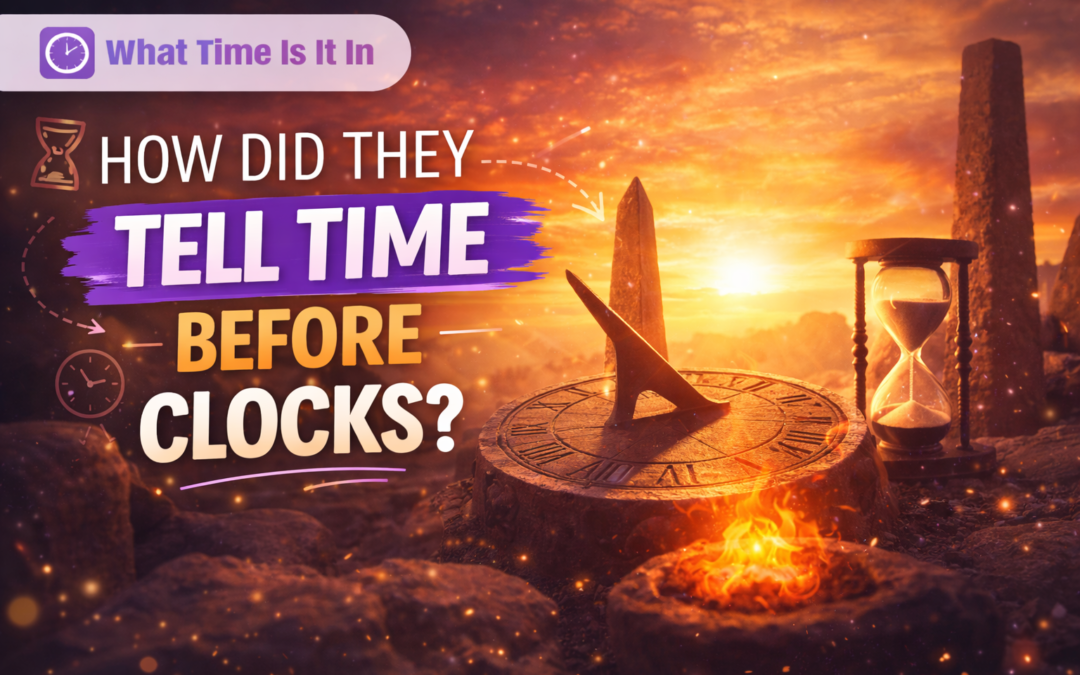
You might glance at your phone for a time, but most of human history required you to read the world itself. If you are asking, “How did they tell time before clocks?” the answer is surprisingly practical, because people relied on repeatable patterns in the sky, water flow, and daily life.
You will see how these methods worked, why they were good enough for work and worship, and what finally pushed timekeeping toward the precision you expect today. Read on as we discuss how people told time before clocks were invented.
You started with the sky because it never stopped moving
Before devices took over, you treated the sky as the most reliable schedule you could access anywhere. You could track sunrise and sunset for the day, the moon’s cycle for the month, and repeating star patterns for seasons, which made planning possible even without numbers. You did not need to know “3:17 p.m.” to act on time, because you only needed a dependable cue that happened in the same order every day.
The sun gave you daytime structure with shadows you could trust
When you watched the sun’s position, you could break the day into working blocks that felt consistent to your body and your community. You could use a simple stick in the ground as a shadow marker, and the changing shadow length and direction helped you estimate morning, midday, and late afternoon with surprising accuracy. In places like ancient Egypt, large monuments such as obelisks served as oversized shadow clocks, allowing you to coordinate public life around a shared reference point.
Why shadows were useful but not perfectly uniform
You could rely on shadows for order, but you could not rely on them for equal-length hours across the entire year. Daylight shifts by season and latitude, so what counted as an “hour” in summer could stretch longer than an “hour” in winter if you used daylight as your ruler. This is why many societies used seasonal hours: they matched lived experience even when they did not align with a fixed unit.
Sundials turned shadow reading into a repeatable tool
Once you carved marks and standardized the shadow-caster, you moved from rough observation to a tool you could teach and copy. A sundial uses a fixed pointer and a calibrated surface, so you can return to the same setup day after day and read time from the shadow’s position. As geometry and astronomy improved, sundial designs also improved, including approaches that angled the pointer to better match the sky’s apparent motion and produce more consistent “equal hours.”
What you gained and what you still lacked
You gained a clearer, more shareable way to tell time during daylight, which helped with governance, markets, and temple routines. You still lacked reliability in cloudy conditions, indoors, and at night, so you needed something that did not depend on sunlight. That limitation is a major reason other tools spread so widely, even as sundials remained culturally important.
At night, you used stars as a moving clock face
When daylight disappeared, you could still time activities by watching which stars rose, crossed the sky, and set in predictable ways. In ancient Egypt, tools like the merkhet helped you align sightlines with key stars, so you could estimate time for ceremonies and coordinate work after dark. If you have ever noticed that certain constellations appear in different seasons, you already understand why star observation could also guide agriculture and long-range travel.
Star timing also helped you build calendars
You did not only need daily timing, because planting and harvesting depend on seasonal timing. By tracking recurring celestial events, you could anchor annual cycles and align festivals, taxes, and labor with predictable seasons. In practice, that meant your community could agree on when “the year turns” even without a numbered clock.
Water clocks let you measure time without sunlight
If you wanted time that worked at night and during clouds, you could measure flow instead of shadows. A water clock, often called a clepsydra, uses a controlled drip or rise of water to mark passing time, so you can track intervals for speeches, shifts, or rituals. Some designs filled a container at a steady rate, while others drained at a steady rate, and both aimed to give you a repeatable measure when the sky could not help you.
The hidden engineering problem you had to solve
Water does not flow perfectly evenly under all conditions, so you had to manage changing pressure as the water level rose or fell. Temperature could also change viscosity, and freezing weather could stop the system entirely, so climate mattered more than most people assume. Even with those limits, water clocks were a major step because they pushed timekeeping toward measurement rather than estimation.
Fire-based timers made time visible indoors
When you needed a timer you could carry into a room, you could use a controlled burn as your reference. Candle clocks and oil lamp clocks work by marking the candle or reservoir, letting you read the time as the fuel level drops at a steady rate. In parts of Asia, incense clocks added another layer, because you could use scent and burn patterns to track intervals for work, prayer, or reminders.
Why fire timers matched real life
You often cared more about an interval than a timestamp, such as how long a meeting lasted or when a guard should switch. A burning timer shines, smokes, and changes shape, so it gives you multiple signals that time is passing even if you cannot stare at it constantly. That practicality is why burn-based tools stayed useful for centuries alongside more mechanical methods.
Hourglasses gave you consistent intervals you could reset fast
When you wanted a reliable interval tool, especially for travel, you could flip an hourglass and start again. Sand flow can be consistent when the glass is well-made and sealed, so you could time watch shifts, navigation routines, and repetitive tasks without looking outside. This matters for ships because waves and wind can disrupt other systems, while an hourglass remains readable as long as you keep it stable.
Why did hourglasses not solve everything?
An hourglass is great for intervals, but it does not automatically tell you the time of day without another reference. You still needed the sun, stars, or a schedule to know whether your “second watch” began near midnight or closer to dawn. That is why hourglasses often worked as partners to astronomical cues rather than replacements.
Daily routines and nature cues helped you stay on time as a community
You did not always need a device because daily life supplies repeating signals that everyone understands. Roosters crow near dawn, grazing animals return at familiar times, and temperature and light shifts create predictable routines for cooking, school, work, and rest. When you combine those cues with local landmarks, you can coordinate plans with phrases like “when the sun touches the big tree,” which is simple but effective in a shared environment.
What this reveals about early timekeeping
You were not failing to be precise, because precision was not always the point. You were optimizing for coordination, safety, and predictability using the tools and signals that were cheap, visible, and widely understood. That social reliability often mattered more than minute-level accuracy.
You lived with “seasonal hours,” so an hour did not always mean sixty minutes
If you measured daylight by dividing it into equal parts, those parts changed length as seasons changed. In summer, daylight stretches longer, so your daylight “hours” could be longer than your winter “hours,” even though the label stays the same. This system fit the rhythms of farming and public life, but it also made it harder to compare time between places and seasons with a single standard.
Why standard time took so long to arrive
You did not need a universal standard until trade, travel, and coordination expanded across regions. Once societies started demanding tighter scheduling for religion, commerce, and administration, the push toward equal hours strengthened. That pressure set the stage for mechanical clocks that could keep a steady beat regardless of the sun.
Mechanical clocks changed time from observation to regulated motion
Early mechanical clocks relied on steady motion and a regulating mechanism, which helped you track time without watching the sky. Once a clock could run continuously, you could ring bells for prayer, open markets on schedule, and coordinate labor with a shared signal even in bad weather. This shift mattered because it separated time from place, since your town could follow a clock even when clouds hid the sun.
What “regulated” really meant for your daily life
A regulated system aims to keep intervals consistent, so an hour becomes closer to the same length every day. That consistency supports contracts, transportation timetables, and shared expectations about punctuality. It also changes culture because it turns time into something you manage more explicitly, rather than something you notice passively.
Quick ways you could estimate time before clocks in everyday life
- You could use a marked shadow line in a familiar spot and adjust your expectation by season, and when you manage travel planning across regions, the logic behind why do we have time zones becomes easier to grasp as a modern extension of older shared references.
- You could watch the brightest stars you recognize and learn the order they appear through the night, which lets you time major blocks such as early night, deep night, and pre-dawn even when you cannot measure minutes accurately.
- You could track a controlled drip or burn for short intervals, then cross-check it against sunrise or sunset for the larger daily frame, giving you a practical blend of measurement and observation that worked in homes, courts, and temples.
What modern time zones share with ancient timekeeping
Ancient methods taught that time depends on where you are, because local noon occurs when the sun rises over your location. When railroads, telegraphs, and nationwide scheduling expanded, you needed a coordinated system that still respected geography, and that is how standardized zones became the practical compromise.
If you ever wondered whether your device handles that complexity for you, will my phone automatically change time zones explains the modern automation that replaces old observation habits.
Why this connection improves your understanding today
You can see that time zones are not arbitrary, because they are a scaled solution to the same local-sun reality people faced for thousands of years. You also understand why “exact time” is an agreement, not a natural object you can hold. That perspective helps you read historical sources correctly, because older records often describe time as events and intervals rather than digits.
How you can think about ancient timekeeping without romanticizing it
You should respect these methods because they were intelligent, repeatable, and aligned with real needs, but you should not pretend they were always precise. People solved problems with the materials available, and they built systems that balanced accuracy, cost, and shared understanding within a community. When you need to compare dates and intervals across sources, a tool like a Date Calculator helps you translate human descriptions into measurable spans without losing the historical context.
The best takeaway for your own daily life
You can become more time-aware by noticing environmental cues rather than relying solely on screens. You can also make better decisions about schedules, travel, and planning when you understand how timekeeping evolved from local observation to global coordination. That deeper understanding keeps you accurate, because you stop assuming that every culture and era treated time the way you do now.
Conclusion
You now know that people told time before clocks by reading the sun, tracking shadows with simple markers, following stars at night, and measuring steady processes like dripping water or burning fuel.
You can also see why these approaches worked well for coordination, farming, and ritual even when they did not deliver minute-level precision, because the goal was dependable order rather than perfect measurement. When mechanical regulation and later standardized systems arrived, they did not replace nature’s logic so much as formalize it, turning observation into a shared, portable, and enforceable schedule.